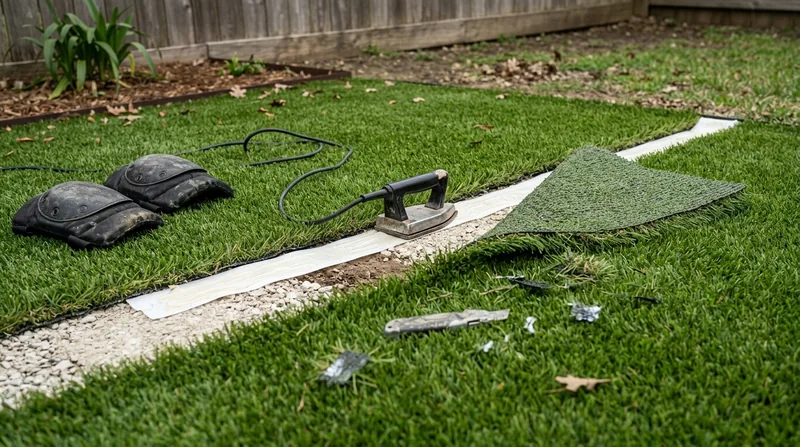




College Station's rolling post oak savannah landscape and the dense clay soils that define the Brazos Valley create specific challenges for artificial turf installations. Summer heat approaching 100 degrees, heavy spring thunderstorms that leave yards waterlogged, and the freeze-thaw cycles of short winters all take a toll on seams, edges and infill over time. When your turf begins to separate at the seams, lift at the perimeter, or flatten in high-traffic zones, turf repair and seam repair in College Station keeps your investment performing and looking finished. We've been handling these repairs since 2013, addressing everything from seam separation in Southwood Valley yards to edge lifting on pool surrounds in Castlegate and Pebble Creek. Whether the damage comes from settling soil, root heave under post oaks, or just years of foot traffic, we locate the problem, specify the fix, and restore the turf to original condition. Call us at (979) 814-4662 for a free estimate, or visit our contact page to request a site visit.
Why Turf Repair and Seam Repair Matter in College Station's Climate
The Brazos Valley's combination of intense summer heat, clay soil movement, and heavy seasonal rains creates stress on artificial turf that flat-ground installations in other climates simply don't face. Seams can separate when the base shifts under water pressure or frost heave, edges lift when soil settles or roots push from below, and high-traffic areas flatten into lanes. Catching these issues early prevents water from pooling beneath the turf, stops pets and children from tripping on lifted edges, and avoids the need for a full replacement down the road.
- We inspect the seam, measure separation, and determine whether re-gluing, patching or full seam replacement is the right fix.
- We locate edge lift caused by soil settling, root pressure or poor base compaction and secure or rebuild the perimeter.
- We address flattened turf in walkways, around pools and on stairs by assessing infill loss and either topping off or replacing the affected section.
- We treat melt damage from window or metal reflections by removing the damaged pile and patching with matching turf.
- We clear debris, pet waste and algae buildup that can accelerate seam and edge failure, especially in shaded yards under post oaks.
Proactive repair extends the life of your turf and keeps the yard safe and attractive year-round.
Key info: In College Station's clay-heavy soils, seam separation often begins at the edge where the turf meets the fence line or patio. We've seen this happen in Southwood Valley and College Hills yards after heavy spring rains when the base swells and then shrinks as it dries. Catching it early keeps the repair cost low and prevents water damage to the subgrade.
For more information on maintaining your turf between repairs, see our turf cleaning and pet odor treatment page.
How We Handle Turf Repair and Seam Repair in College Station
Every repair starts with a site visit where we assess the damage, identify the root cause, and specify the exact work needed. We don't patch without understanding why the turf failed. If the base is settling unevenly, we address the drainage first. If the seam separated because of poor installation, we cut it out and re-seam it to specification. If infill has migrated or compacted, we measure what's needed and restore it to the original depth and density.
- We photograph the damage and document the turf product, face weight and pile height from your original install or best available records.
- We test the base for compaction, drainage and settlement, and probe for root or utility lines that might be causing heave.
- We quote the repair scope: whether it's a simple re-glue, a seam replacement, an infill top-off, a patch or a combination.
- We schedule the work at a time that avoids weather (no seaming in rain, no infill work in extreme heat) and coordinate around your schedule.
- We perform the repair using the same product, face weight and installation method as the original, or source a match if the original is no longer available.
- We clean the repaired area and verify that the turf sits flush, the seam is sealed and infill is level before we leave the site.
The goal is a repair that blends seamlessly with the existing turf and lasts as long as the rest of the yard.
Local example: A homeowner in Pebble Creek had a seam separate along the edge of their pool surround after a hard winter freeze and spring thaw cycle. We identified soil heave under the turf, re-compacted the base with proper drainage, removed the damaged seam, and re-glued it with a commercial-grade polyurethane sealer. The repair took one day and cost far less than replacing the entire 200-square-foot surround. See our pool surround turf page for more on pool-specific installation and repair.
Repair Methods and Techniques
| Repair Approach | Description | Best For |
|---|---|---|
| Seam Re-gluing | We clean the seam, apply commercial-grade polyurethane adhesive, and clamp or weight the turf until it sets. No cutting required if the turf pieces are still aligned. | Minor separation less than 1/4 inch, recent installations or seasonal expansion. |
| Seam Replacement | We cut out the damaged seam section (typically 6 to 12 inches on each side), remove old adhesive and infill, and glue in a new seam with matching turf using the same product and face weight. | Separation wider than 1/4 inch, failed adhesive, or seams damaged by UV or freeze cycles. |
| Edge Securing and Rebuild | We pull back the lifted edge, assess the base for settling or root heave, re-compact or re-grade as needed, and re-secure the edge with adhesive and/or fasteners to the perimeter. | Lifted edges along fences, patios, pools or walkways caused by soil movement or poor initial installation. |
| Infill Restoration | We vacuum or rake out compacted or migrated infill, measure the depth, and add the correct type and amount of infill (zeolite, crumb rubber or other material per spec) to restore the original density. | Flattened traffic lanes, areas with pet urine odor, or yards where infill has settled unevenly over time. |
| Melt and Damage Patching | We identify the cause (window glare, metal reflection, chemical spill), remove the damaged pile section, and glue in a patch of matching turf or replace the entire affected area. | Localized damage from heat, UV, chemicals or physical trauma that doesn't affect the base or surrounding turf. |
Each approach is chosen based on the damage type, the age of the turf and whether the base has shifted. We always specify the method in writing before we begin work.
Turf Repair and Seam Repair Cost in College Station: What to Expect
Repair costs depend on the scope of damage, the size of the affected area, whether the base needs work, and how much of the original turf product is still available. A simple seam re-glue on a small separation might start at $350 to $500. A full seam replacement over 10 to 15 linear feet, or an edge rebuild with base re-compaction, typically runs $600 to $1,200. Larger jobs such as infill restoration across multiple zones or multiple seam repairs in different parts of the yard may cost $1,500 to $2,500 or more. Travel is included within College Station and surrounding areas, and we always provide a free estimate on site before any work begins.
The best way to understand the cost for your specific repair is to call us at (979) 814-4662 or request a free estimate through our pricing page. We'll visit your yard, assess the damage, and give you a firm quote with no obligation. Factors that affect the final cost include the turf product and face weight (which determines how much matching material costs), the size of the repair area, whether the base needs re-compaction or drainage work, and the accessibility of the site (tight spaces between fences or under trees cost more to work in).
Many homeowners ask whether repair is worth the cost compared to replacement. In most cases, if the damage is limited to one or two seams, an edge, or a small flattened zone, repair is far cheaper than a full turf replacement and extends the life of your yard by years. If the turf is more than 10 years old or if multiple large areas are damaged, replacement may be the better option. We'll give you honest guidance on both paths during the estimate.
What to Look for When Hiring a Turf Repair Company Near Me in College Station
When you're searching for a turf repair company near College Station, the same standards apply whether you're hiring for a small seam fix or a major restoration. Start by asking for proof of insurance, including a certificate of general liability and workers' compensation. Request a written specification of the work to be done, including the turf product name, face weight, pile height, infill type and depth, and any base work required. Call or visit at least two or three companies to compare their approach, their knowledge of the local soil and climate, and their pricing. Check references and ask to see photos of finished repairs in similar yards in College Station, Bryan or nearby towns.
- Verify that the company has a local address and can be reached by phone or email in College Station, not just through a web form.
- Ask how long they've been in business and whether they have experience with the specific issue you're facing (seam separation, edge lift, infill loss).
- Confirm that they use the same product and face weight as your original turf, or can source a documented match if the original is discontinued.
- Clarify what warranty they offer on the repair work itself (typically one to three years on labor and seams, not on the turf manufacturer's material).
- Get the estimate in writing, with a start date and completion timeline, and ask whether they'll handle any base work or drainage issues they discover during the repair.
- If your yard is in an HOA community, confirm that the repair method complies with any architectural guidelines (most seam repairs and edge work do, but it's worth checking).
A reputable turf installation company will answer these questions clearly and won't rush you into a job. For more guidance on choosing a turf installer, visit our contact page to speak with us directly or request an estimate at (979) 814-4662.
Turf Repair & Seam Repair in College Station: Pricing Guide
| Service | Price | Details |
|---|---|---|
| Seam re-gluing | Starting at $350 | Simple re-adhesion of separated seam less than 1/4 inch, no cutting or infill work required, typical completion same day |
| Seam replacement | Starting at $600 | Removal and replacement of damaged seam section 6 to 15 linear feet, matching turf product and face weight, one to two day timeline |
| Edge securing and base repair | Starting at $700 | Edge lift repair with soil assessment, re-compaction and re-adhesion along fence line or patio, includes drainage evaluation |
| Infill restoration | Starting at $500 | Removal of compacted infill and restoration of original depth and density across high-traffic area, cost varies by square footage and infill type |
| Multiple repairs or large-scale work | On estimate | Combination of seam, edge and infill repairs across multiple zones or yards with base issues requires on-site assessment before pricing |
| Free estimate | No charge | Site visit, damage assessment and written repair scope provided within 24 hours, (979) 814-4662, no obligation to book |
Indicative pricing, the exact cost depends on square footage, finish, and site access. Free personalized estimate within 24h at (979) 814-4662.


